1. Introduction
Health is a fundamental human right. Advancing health equity means working to ensure everyone can realize their right to health. An understanding of health inequities in populations – the differences in health between groups of people that are unfair, avoidable or remediable – helps to inform actions to address them.
Measuring health inequalities entails quantifying the differences in health between population groups that may be associated with social advantage or disadvantage (1). It relies on disaggregated health data, which provide information about health for specific population subgroups defined by, for example, demographic, socioeconomic or geographic characteristics. Monitoring makes repeated measurements over time to look for changes and trends. Accordingly, health inequality monitoring assesses the magnitude and direction of health inequalities and how they have changed over time.
Health inequality monitoring brings attention to persisting, widening or emerging inequalities in health. It can also help to identify situations of narrowing inequalities, which may lead to insight into strategies and best practices for improving health equity, and help to evaluate policies and programmes. Beyond supporting the identification of health inequities, such measurements can help to inform policies and interventions that reach the whole population, while enabling more targeted and tailored efforts for groups with the greatest need, supporting efficient use of limited resources. Evidence increasingly shows that prioritizing populations that are furthest behind can accelerate improvements in overall population health and contribute to broader socioeconomic development (2).
Health inequity: unfair, avoidable or remediable differences in health among groups of people. Health inequity is rooted in the unfair distribution of, and unfair access to, power, wealth and other social resources. It is linked to forms of disadvantage that are socially produced, such as poverty, discrimination, and structural barriers to accessing services or goods.
Health inequality: measured difference in health between population subgroups. Health inequalities can be measured and monitored. For the past three decades, the term has been used globally to refer to health differences associated with social advantage and disadvantage.
Disaggregated health data: health and health-related data broken down by population subgroups defined by one or more dimensions of inequality, such as age, sex, economic status or place of residence. Disaggregated data can show underlying inequality patterns that are not evident from overall averages across a population.
1.1 Inequality monitoring within health information systems
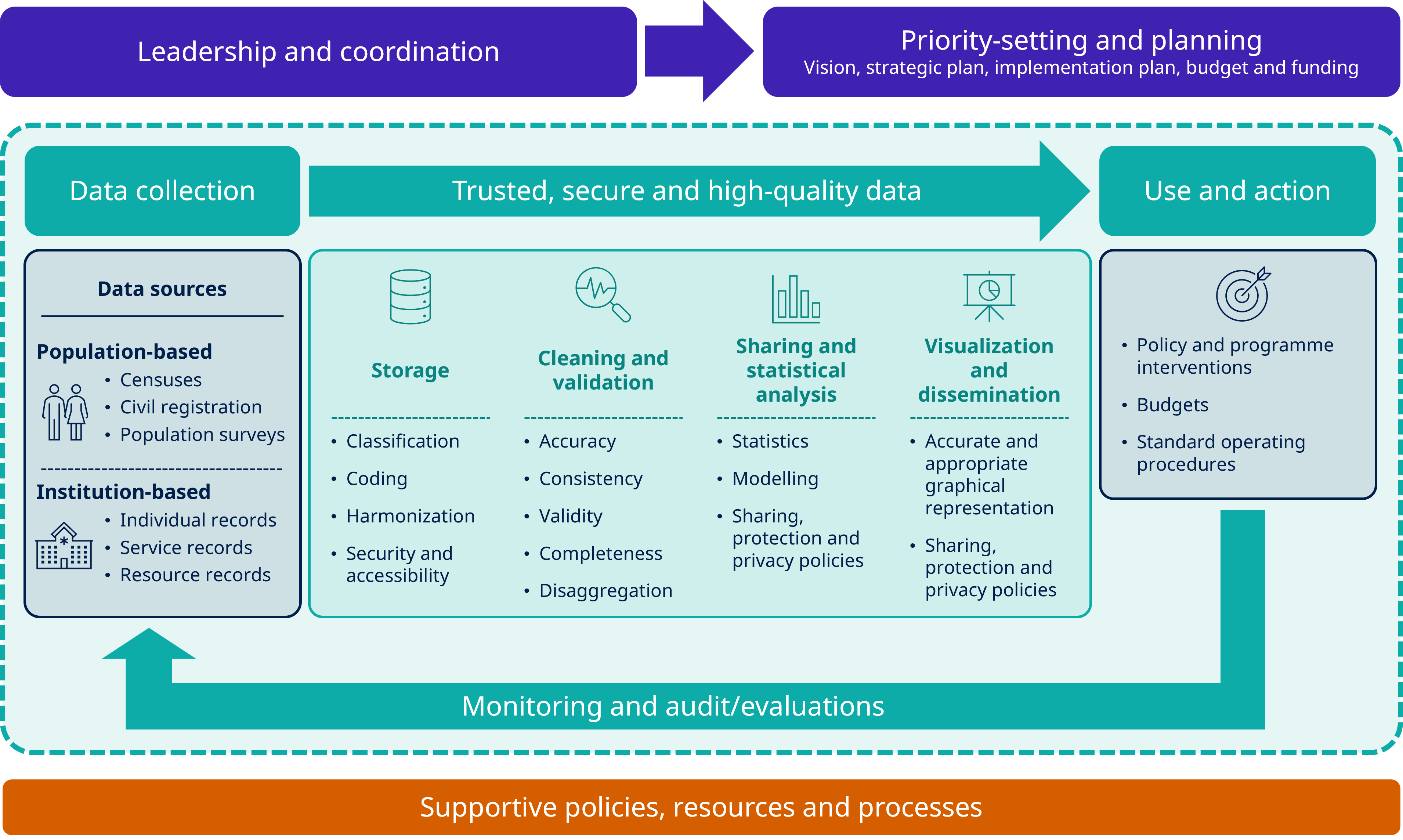
Health information systems provide the infrastructure, data sources, governance arrangements and analytical processes needed to generate and use information for health planning, monitoring and evaluation (3). When health inequality monitoring is integrated into health information systems, it can generate regular, reliable evidence on health inequalities. Establishing inequality monitoring as part of health information systems entails the following:
Leadership and coordination: overarching political will, leadership and coordination provide high-level policy commitment to health inequality monitoring. This includes defining monitoring priorities, aligning actors across sectors, ensuring accountability, and allocating sustainable financing that underpins the continuity and quality of data collection, analysis and reporting over time.
Priority-setting and planning: inequality-related commitments, priorities, indicators and targets are incorporated into health policies and strategic plans. In mature systems, a national health inequality monitoring framework is developed and implemented.
Data collection: data sources such as national population-based health surveys, censuses, civil registration and vital statistics (CRVS) systems, and routine health information systems collect information about health and key demographic, socioeconomic and geographic characteristics. These data sources contain disaggregated data that are reliable, ethical, timely, accessible and representative of population subgroups. Robust data storage systems are supported by appropriate data governance mechanisms to produce high-quality, trusted and secure data.
Data analysis, reporting and use: data are cleaned, validated, linked and analysed to generate disaggregated health indicators and inequality measures. Investments in human resources and technologies support technical capacities to analyse, interpret and report these data. Outputs such as reports and dashboards facilitate the routine use of inequality evidence by decision-makers. There are regular and dedicated opportunities for evaluating and applying evidence about health inequalities, and for refining inequality monitoring priorities. The use of inequality data leads to the demand for more data, which provides impetus and resources for further development of health inequality monitoring systems.
Supportive policies, resources and processes: investments in resilient, integrated and sustainable data and digital health ecosystems facilitate collection, linkage and processing of disaggregated data. Incorporating resilience and emergency preparedness into system design helps to maintain continuity of core data functions during shocks and crises. Stakeholder engagement mechanisms help ground monitoring in lived realities and build trust. Robust legal, ethical and data governance frameworks safeguard privacy and confidentiality through secure storage, de-identification of personal information, controlled data access, clear accountability mechanisms, and the collection and use of only the data necessary for legitimate public health purposes. These measures help to build trust among populations to share their data. Adequate human resources, with skills spanning data collection, statistical analysis, interpretation and communication, translate disaggregated data into actionable evidence for reducing health inequalities.
These processes, summarized in Fig. 1., contribute to stronger health inequality monitoring, ultimately aiming to advance health equity.
Fig. 1. Integration of health inequality monitoring into country health information systems
Adapted from Health Metrics Network and World Health Organization (3).
Countries differ substantially in the maturity of their health information systems, which impacts health inequality monitoring resources, capacities and practices. The SCORE1 for Health Data Technical Package is the WHO core framework for assessing country health information systems. The 2025 assessment found variation across system components and countries (Box 1) (4). WHO supports health inequality monitoring and general health information system strengthening efforts across Member States (Box 2).
Box 1. SCORE 2025 global assessment
A total of 145 countries participated in the 2025 SCORE assessment. Of these, 114 countries had also participated in an assessment in 2020 (4). Between 2020 and 2025, countries made measurable progress in health information system capacity, with the greatest improvements observed in low- and lower-middle-income countries.
Despite this progress, the assessment identified important weaknesses within specific parts of health information systems and across systems as a whole. These include:
declining survey production;
weak digital foundations in many settings, especially with health facility data;
limited secure data-sharing mechanisms;
persistent gaps in CRVS and cause-of-death reporting.
Box 2. WHO support for health inequality monitoring
Capacity-strengthening: WHO provides technical assistance, training and knowledge exchange opportunities to strengthen national capacity for collecting, analysing, interpreting and reporting inequality data.
Evidence generation and dissemination: WHO produces global, regional and country-level analyses of health inequalities to highlight the state of health inequality and showcase best practices in reporting health inequality data.
Tools, resources and best practices: WHO develops methodological guidance, software and practical resources for health inequality monitoring. It also produces guidance on monitoring the social determinants of health equity, and tools to support stronger health information systems, data governance and digital health infrastructure. Health inequality monitoring capacity-strengthening, publications, tools and resources are available via the Health Inequality Monitor website (https://www.who.int/data/inequality-monitor).
Relevant resources are highlighted in the “Tools and resources” sections of Chapters 3–5.
1.2 Report aims and objectives
To date, no study has systematically and comprehensively assessed health inequality monitoring capacity globally. The WHO SCORE 2020 and 2025 assessments examined selected aspects of disaggregated data availability (4, 5). Other analyses have assessed the inclusion of inequality data in national data repositories across 42 countries (6). Regional studies have documented patterns of disaggregated data availability in the Western Pacific Region (7) and in Association of Southeast Asian Nations countries (8), the integration of health equity considerations into national health plans in the Region of the Americas (9), and aspects of health inequality monitoring in European countries (10, 11). A study of 36 high-income countries evaluated capacity to monitor health inequalities related to socioeconomic status (12). Another study evaluated the capacity of 52 Member States of the WHO European Region to monitor health inequalities related to migration status (13). Collectively, these studies demonstrate ongoing and expanding efforts to understand and strengthen inequality monitoring at the national and regional levels.
The Health inequality monitoring atlas was developed by WHO to provide the first global mapping of health inequality monitoring capacities, resources, policies and practices in Member States. The Atlas assesses several key features of national health inequality monitoring systems, but it does not assess the full range of capacities, resources, policies and practices that are necessary for a robust system, or their maturity, quality, implementation or policy impact. It aims to generate initial insights needed to identify actions for strengthening health inequality monitoring systems and practices worldwide.
The objectives of this report are to:
provide a snapshot of the status of health inequality monitoring systems in participating Member States;
summarize the overall strengths, common gaps and strategic directions for improvement with regard to health inequality monitoring;
identify best practices and opportunities for knowledge-sharing through examples and case studies from countries.
Each participating country submitted self-reported information via a questionnaire covering selected components of health inequality monitoring systems. The results are presented in three chapters corresponding to leadership, priority-setting and planning; collecting health inequality data; and analysing and reporting health inequality data.
Global and country-level data for the Atlas are available in the interactive data visualizations and country profiles that accompany the report at https://www.who.int/data/inequality-monitor/publications/atlas_2026.
SCORE: survey populations and health risks; count births, deaths and causes of death; optimize health service data; review progress and performance; effective use of data and evidence for policy and action.↩︎